Why Does a Psychoeducational Assessment Cost So Much?

If you've started looking into a private psychoeducational assessment for your child, the cost may come as a surprise.
In Southern California, a comprehensive private psychoeducational evaluation often ranges from about $4,500 to $6,500, with more complex evaluations sometimes costing more.
So what are families actually paying for?
A psychoeducational assessment is much more than a few hours of testing. It can involve 15–25+ hours of professional work, including preparation, testing, scoring, interpretation, record review, report writing, and a detailed feedback session.
The goal is not simply to generate test scores. It is to understand how your child learns, what may be getting in the way, and what kind of support may help.
Why Families Seek an Assessment
Parents usually pursue an evaluation because something isn't adding up.
Maybe your child is bright but struggling to read. Homework takes much longer than expected. Teachers describe them as distracted, anxious, inconsistent, or unmotivated.
Sometimes a child is doing well academically, but parents can see how much effort it takes to keep up.
The challenge is that similar struggles can have very different causes.
Reading difficulties may be related to dyslexia. Trouble completing assignments may involve ADHD or executive functioning. Anxiety, processing speed, working memory, perfectionism, or other factors may also play a role.
Often, more than one thing is happening at the same time.
A comprehensive assessment helps answer the bigger question:
Why is this difficult for my child?
Once families understand the why, they can make better decisions about what to do next.
What Does a Psychoeducational Assessment Include?
Every child is different, so there is no single testing package that works for everyone.
Depending on the concerns, an evaluation may look at areas such as:
Cognitive abilities
Academic achievement
Reading and dyslexia-related skills
Attention
Executive functioning
Memory
Processing speed
Language
Social and emotional functioning
Behavior
Autism-related characteristics
The process may also include reviewing school records, previous evaluations, report cards, intervention data, parent questionnaires, and teacher input.
The actual testing is only one part of the evaluation.
After testing is complete, the evaluator must score the measures, compare results across different areas, look for patterns, consider possible diagnoses, and determine whether another explanation may better account for the difficulties.
That interpretation is where much of the professional expertise comes in.
So, Where Does $5,000 Go?
Using a $5,000 evaluation as an example, the largest portion of the fee, roughly 55–60%, typically reflects the evaluator's professional time and expertise.
This includes direct testing, scoring, interpretation, diagnostic decision-making, developing recommendations, and writing the final report.
Another 10–15% may go toward assessment materials and testing tools. Standardized tests can be expensive to purchase and maintain, and many include additional costs for testing protocols, digital scoring, parent and teacher rating scales, or specialized online platforms.
Around 10–15% may cover the work surrounding the evaluation, such as reviewing records, communicating with teachers or other providers, preparing for testing, and meeting with parents to review results.
The remaining 15–20% helps cover the professional and operational costs required to provide assessments responsibly. This may include licensing, liability insurance, continuing education, secure technology and record keeping, administrative support, office expenses, and keeping assessment materials current.
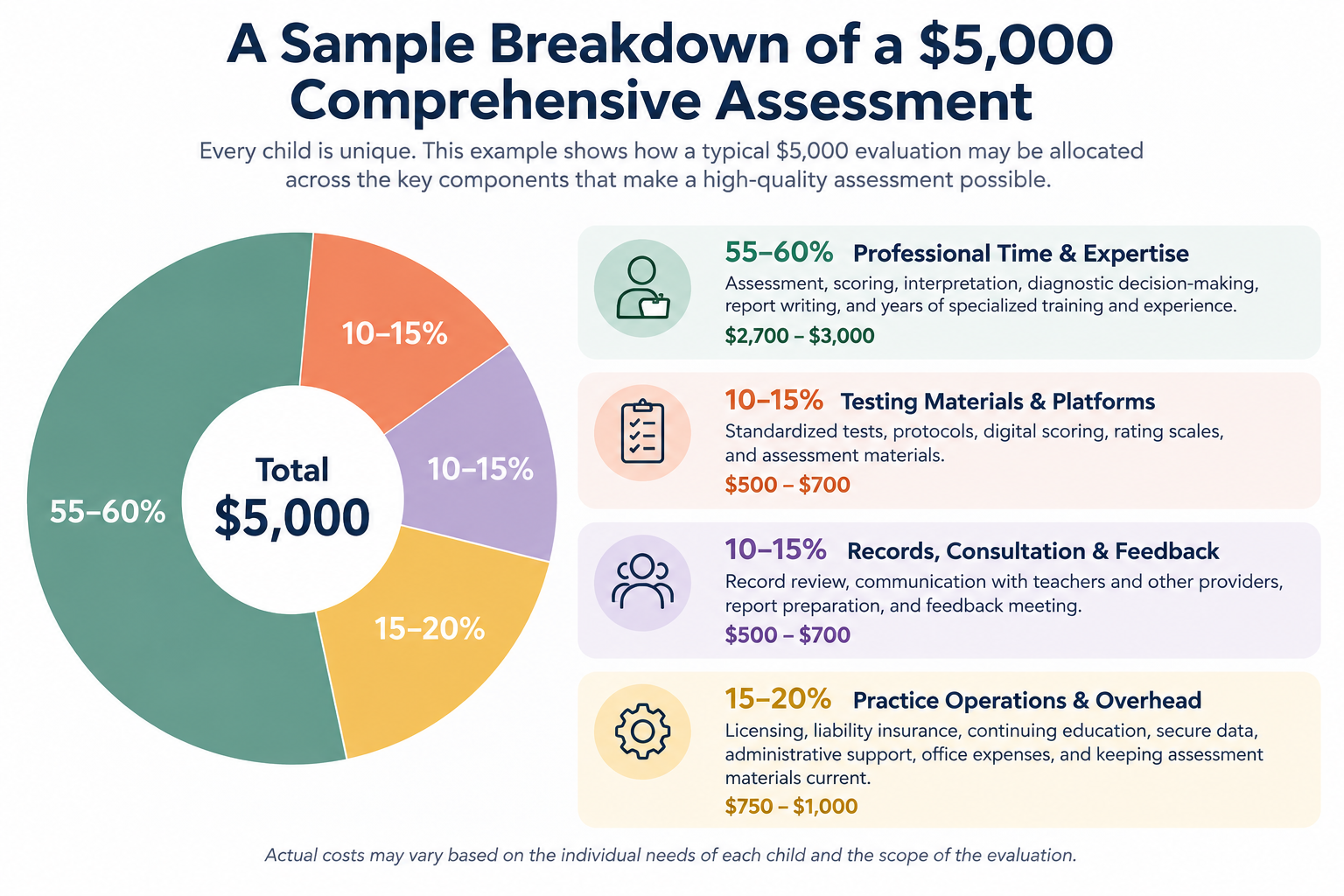
These percentages are intended to provide a general picture rather than an exact itemized breakdown. Every evaluation is different, and the amount of testing, consultation, and professional time required can vary.
Why Some Assessments Cost More Than Others
A child being evaluated primarily for dyslexia may need a very different assessment than a child with questions involving ADHD, autism, anxiety, memory, executive functioning, and academic performance.
More complex evaluations may require:
Additional testing sessions
More specialized assessment measures
Extensive record review
Teacher consultations
School observations
Communication with therapists, physicians, or other professionals
This is why some practices use "starting at" pricing instead of charging one flat fee for every child.
A good evaluation should be built around the child and the questions being asked, not around a predetermined testing package.
Why Getting the Right Diagnosis Can Help
Some parents worry about giving their child a label.
But identifying dyslexia, ADHD, autism, anxiety, dysgraphia, or another learning difference does not “label” the child; It gives a name to something the child is already experiencing and protections that come with having a diagnosis.
Without an explanation, children often create their own.
They may begin to think:
"I'm bad at school."
"I'm not smart."
"Everyone else can do this. Why can't I?"
An accurate evaluation can replace that uncertainty with understanding.
A child might instead learn:
"Reading is harder for my brain because I have dyslexia, but now we know what helps."
That understanding can also help parents, teachers, and other professionals provide more appropriate support.
An Assessment Should Lead to a Plan
A diagnosis by itself is not the goal. It is also crucial to identify a child’s strengths and provide guidance on neurodiversity-affirming care.
A useful psychoeducational assessment should help families understand what comes next through evidence-based recommendations that are customized to their child’s profile.
Depending on the findings, recommendations may help guide:
Academic interventions
IEP or 504 accommodations
Reading support
Executive functioning support
Counseling/Therapy
Parent strategies
Classroom accommodations
School planning
Additional medical or therapeutic referrals, such as OT or Speech Therapy
For many families, this is where the value of the assessment becomes most clear.
Instead of trying one strategy after another and hoping something works, they have a clearer picture of what exactly their child needs.
What About Insurance?
Insurance coverage for psychoeducational testing varies widely. When testing is targeting a medical condition such as ADHD, Anxiety or Autism, there may be potential reimbursement from insurance.
Because these evaluations often address educational and learning concerns, some health insurance plans do not consider all parts of the evaluation medically necessary. For example, if the evaluation is looking at dyslexia, a learning disorder, insurance companies do not consider that a medically relevant condition.
Families may have out-of-network benefits or may be able to submit a superbill for possible reimbursement.
It is best to obtain a good faith estimate (GFE) for the exact cost of assessment, contact your insurance provider directly and ask about psychological or neuropsychological testing, out-of-network benefits, deductibles, and reimbursement requirements.
The Real Value of a Psychoeducational Assessment
The value of an assessment is not the number of tests given or the length of the final report.
It is having a clear explanation of your child’s profile and a practical plan for what to do next to enhance their strengths and support their differences.
A strong evaluation should help families understand:
Where their child is experiencing challenges
What is contributing to those difficulties
Whether a diagnosis(es) is appropriate
What strengths can be used to support learning and success across environments
Which interventions or accommodations are most likely to help
What parents and schools should focus on next
That clarity can change how a family approaches school, homework, treatment, accommodations, and future decisions.
Instead of continuing to ask, “Why isn’t this working?” parents can move forward thinking, “Now that we understand how my child learns, we have a roadmap for what they need to thrive.” With greater clarity comes the ability to make more informed and confident decisions about their child’s support and next steps.
At Empower Child Learning, the goal is not simply to identify a diagnosis. It is to give families useful answers they can act on.
A comprehensive assessment should leave you with a better understanding of your child and a clearer path forward.
Ready for more clarity about how your child learns? ECL offers comprehensive, strengths-based psychoeducational assessments designed to help families understand the why behind their child’s challenges and leave with practical next steps.
Schedule a free 30-minute phone consultation with one of our psychologists HERE. We’ll learn more about your child, discuss your concerns, and decide together whether an evaluation may be the right next step.